
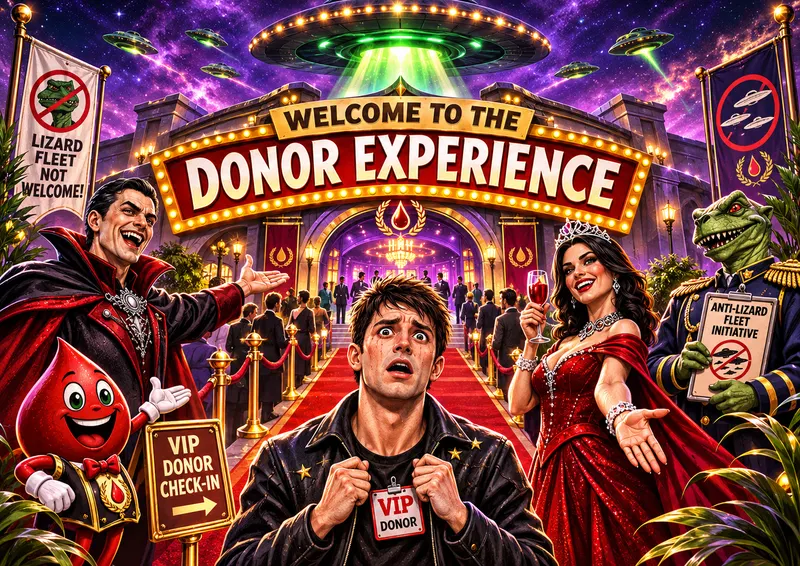
Welcome to the Donor Experience: The Vampire Satire That Might Be Predicting Humanity's Future
What if humanity's greatest threat isn't an alien invasion, but our willingness to embrace it? Beneath the outrageous humor of Welcome to the Donor Experience lies a chilling commentary on cultural conditioning, manufactured consent, and the power of propaganda. From romanticized monsters to government-sanctioned blood donations, this brilliantly twisted song might be less science fiction than we'd like to believe.
Welcome to the Donor Experience: The Song That Makes You Laugh at Humanity's Future—Until You Realize It Might Be Predicting It
What happens when humanity becomes so obsessed with acceptance, entertainment, and appearances that it willingly welcomes its own predators? “Welcome to the Donor Experience” offers a hilariously disturbing answer, wrapped in a song whose absurdity may be disguising something remarkably profound.
At first listen, “Welcome to the Donor Experience” sounds like an outrageous science-fiction comedy. Vampires from outer space arrive on Earth, humanity becomes their preferred food source, and somehow the entire situation is transformed into a glamorous public-relations campaign.
There are blood-type personality quizzes, celebrity vampires, corporate enrollment booths, television personalities defending the arrangement, and an interplanetary military threat that conveniently requires human sacrifice.
It's ridiculous.
And that may be precisely why the song is so unsettling.
Beneath its irreverent humor lies a remarkably sophisticated examination of cultural conditioning, manufactured consent, institutional propaganda, and humanity's extraordinary ability to normalize almost anything.
More provocatively, the song raises a question that moves beyond satire into the territory of speculative prophecy:
What if humanity's greatest vulnerability isn't that we would fail to recognize monsters, but that we could be persuaded to admire them?
The Internet Wasn't Just Entertainment. It Was Preparation.
The song opens with the unmistakable soundscape of the early internet: shrieking dial-up modems, blinking advertisements, and chaotic message boards.
It's an amusing nostalgic introduction, but the timeline matters.
The narrator remembers a world in which the internet promised connection, knowledge, and unprecedented human progress. Yet somewhere along the way, the technology that was supposed to liberate humanity became a mechanism capable of reshaping its desires.
The song charts that transformation through the changing portrayal of vampires.
Once horrifying creatures of the night, vampires gradually became beautiful, misunderstood, seductive, and emotionally complex. Popular entertainment transformed predators into romantic protagonists.
The lyrics describe this evolution almost clinically: monsters acquire attractive faces, luxurious wardrobes, and tragic backstories. Their consumption of human blood becomes increasingly elegant and socially acceptable.
This is more than a joke about vampire romances.
It's a commentary on how culture can change our moral instincts by changing what we find attractive.
Repeated exposure doesn't automatically create acceptance, but it can influence what audiences perceive as familiar, sympathetic, or desirable.
The song takes that principle to its most absurd conclusion.
By the time actual extraterrestrial vampires appear, humanity has already spent decades learning to romanticize them.
The invasion arrives with its marketing campaign effectively completed.
The Soft Launch of the Apocalypse
One of the song's most devastating observations is that the transition from entertainment to institutional authority barely registers.
The pre-chorus announces that what began as a soft launch has become official protocol.
That single progression captures an entire theory of social normalization.
First, an idea appears in fiction. Then it becomes fashionable. Eventually, it enters public conversation, corporate messaging, and institutional policy.
The song doesn't claim every cultural trend is deliberately engineered. Instead, it imagines a society so accustomed to accepting carefully packaged ideas that a genuinely horrifying development becomes just another administrative adjustment.
Even the language of victimhood disappears.
Humans aren't livestock.
They're donors.
They're not being harvested.
They're participating in an experience.
And the creatures consuming them aren't occupying forces.
They're ambassadors.
The genius here is linguistic. The song understands that whoever controls the vocabulary can profoundly influence how people interpret reality.
Change the terminology, improve the branding, and even exploitation can begin to resemble an opportunity.
The Perfect Enemy: Anti-Lizard Propaganda
Perhaps the song's sharpest political observation is hidden inside its funniest recurring justification.
The vampires apparently need human blood to finance a military fleet protecting Earth from hostile lizard creatures.
Suddenly, human consumption isn't exploitation.
It's national—or perhaps planetary—security.
Notice what the arrangement accomplishes.
The vampires establish themselves as protectors while simultaneously benefiting from the very population they're supposedly defending.
The existential threat creates a justification for sacrifice, discourages dissent, and makes ordinary people feel morally obligated to participate.
Questioning the arrangement could now be characterized as jeopardizing humanity's survival.
The song never establishes whether the lizard threat is genuine, exaggerated, or entirely fabricated.
That ambiguity is essential.
The satire works whether the danger is real or not, because the deeper question concerns how easily fear can be used to justify an unequal relationship.
When the people claiming to protect you also profit from your submission, who gets to decide whether the sacrifice is necessary?
It's a question with implications far beyond science fiction.
Your Blood Type Is Your Personality Now
The second verse delivers another inspired prediction: apps matching humans with vampire overlords through blood-type personality quizzes.
It's comedy built from technology we already recognize.
Modern digital platforms routinely invite users to surrender personal information in exchange for entertainment, convenience, personalization, or a sense of belonging.
The song imagines the ultimate escalation.
Your biological characteristics become marketable assets. Your pulse becomes a personality trait. Your suitability for consumption becomes something an algorithm can calculate.
Even the vampire assigned to the narrator has a dramatic name and an aristocratic identity.
Cassian isn't presented as a terrifying parasite. He's practically a dating-app match.
The implications are disturbing.
The system doesn't merely demand participation. It makes people curious about which predator would prefer them.
That's a remarkably efficient form of control: persuading individuals to experience their own commodification as personal validation.
The song's invented world is fantastical, but its understanding of gamification, data collection, and status-driven consumer behavior is uncomfortably recognizable.
The Most Terrifying Characters Aren't the Vampires
One of the composition's cleverest decisions is to keep its most recognizable villains almost entirely in the background.
The vampires exist, certainly.
But much of the song focuses on the ordinary humans facilitating their system.
Television hosts explain away the obvious. Wellness representatives celebrate participation. Corporate booths offer commemorative merchandise. Event staff manage the logistics.
Nobody appears particularly shocked.
The machinery of exploitation runs with the efficiency of a well-organized promotional event.
That may be the song's most disturbing insight.
A monstrous system doesn't necessarily require monstrous people to operate it.
It can function through ordinary individuals following procedures, repeating reassuring phrases, and performing their jobs.
The string quartet playing while the narrator is weighed is especially brilliant imagery.
Civilization has not disappeared.
Art, elegance, hospitality, and ceremony remain intact.
They've simply become decorations surrounding something horrifying.
The apocalypse isn't accompanied by screaming crowds.
It has excellent customer service.
A Prophecy Hidden Inside a Punchline?
Could “Welcome to the Donor Experience” be interpreted as a prophecy?
Not in the literal sense of providing evidence that extraterrestrial vampires will arrive.
Its predictive power is more interesting than that.
The song extrapolates recognizable social patterns toward an outrageous future and challenges listeners to identify exactly where the absurdity begins.
Celebrity worship, algorithmic profiling, corporate euphemisms, security-driven messaging, parasocial obsession, and the commercialization of personal identity already exist.
The fictional vampire invasion merely combines them into one spectacularly grotesque destination.
It also raises an intriguing possibility: if humanity encountered an extraordinary new intelligence or civilization, would our response be shaped primarily by scientific curiosity and independent judgment—or by entertainment, political messaging, commercial incentives, and social pressure?
The song imagines humanity encountering the incomprehensible and immediately turning it into merchandise, influencer content, and a registration process.
That's not a documented prediction.
It's a satirical warning about the habits we might carry into an unprecedented future.
And warnings can be valuable without being supernatural.
The Final Insult: Humanity Goes Willingly
For all its extravagant worldbuilding, the song concludes on an intimate, painfully human note.
The narrator is standing in line, wearing an inexpensive shirt, frightened and overwhelmed, trying desperately to appear significant.
There's no heroic rebellion.
No triumphant resistance.
No grand declaration of independence.
Just an ordinary person attempting to maintain dignity while awaiting an indignity he cannot escape.
The comedy suddenly becomes existential.
Throughout the song, humanity has been encouraged to treat submission as honor, exploitation as service, and terror as an exciting historical milestone.
Now the narrator is living inside that manufactured narrative.
He knows something is wrong.
But he's still standing in line.
And that is the song's ultimate accusation: perhaps the greatest danger isn't that humanity could be conquered, but that humanity could learn to celebrate its own conquest.
Why This Song Deserves More Than a Laugh
“Welcome to the Donor Experience” succeeds because it operates simultaneously as absurdist comedy, science-fiction storytelling, cultural criticism, and speculative social commentary.
Its humor makes its ideas accessible. Its escalating imagery makes them memorable. Its recurring promotional language reinforces the unsettling contrast between what people are told is happening and what is actually happening.
Most importantly, it never needs to abandon the joke to make its point.
The laughter and the horror come from the same realization.
A civilization capable of transforming predators into celebrities, exploitation into privilege, and sacrifice into a fashionable public service might not recognize its own destruction until the paperwork was already signed.
Whether listeners interpret the song as satire, cautionary fiction, or an eerie forecast of humanity's relationship with power, its central question lingers long after the final note:
If the end of the world arrived with beautiful branding, celebrity endorsements, patriotic messaging, and a complimentary membership pin, how many of us would recognize it before joining the line?
And perhaps more importantly—
How many would be excited to get in first?
Did this story earn your props?
Give Pixel Props to let the author know you enjoyed it. When a regular Prop is not enough, go all in with All the Props.
Your Prop and display name are visible privately to the author. They are not displayed publicly on your reader profile.
You gave this story everything.
That is City Pixels’ superfan signal. Keep up with Jason Neil and see what comes next.
Stay connected to this author.
Checking whether this author is already part of your followed authors.
Save this story for later
Pin this story to keep it in your Pixel Passport and include it in your personalized Pixel Stream.